· Dinesh Gajjar · Insights · 6 min read
The Machine in the Shed
Two of our products were never on a roadmap. They were born while we were solving a client's problem, and we were their first customer.
People sometimes imagine that a software company decides to build a product the way one decides to open a new branch. A meeting is called, a market is studied, a roadmap is drawn, and then the building begins.
That is not how either of our two products came to life.
Neither of them began on a whiteboard. Both of them began in the middle of a client’s problem, at a moment when we were simply trying to get a job done well. We did not sit separately to invent something. We went looking for a solution that already existed, and what we found taught us more than we expected.
A widow, a shed, and a broken china crockery set
In the 1880s, in the small town of Shelbyville, Illinois, there lived a woman named Josephine Cochrane. She was known for hosting generous dinners, and she served them on a fine heirloom china crockery set that had been in her family for generations. After each dinner, the china set went to the kitchen to be washed by hand, and piece by piece, it came back chipped.
She tried washing it herself. It was slow, tiring work, and the china set still chipped. So she looked for a machine that could do the job. Machines for washing dishes did exist; others had patented them before her. But none of them did what she needed. They scrubbed, they splashed, and they were not gentle enough for what she valued most.
Then, in 1883, her husband died suddenly, and she discovered that he had left her with very little money and a good deal of debt. What had begun as a household irritation now became a necessity.
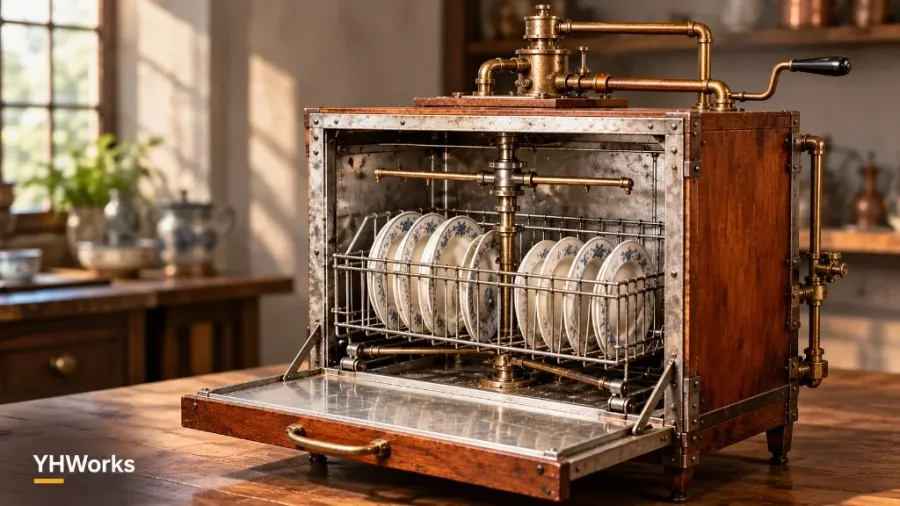
Josephine was not trained as an engineer. But she knew her own problem better than anyone alive. She measured her plates, cups, and saucers one by one, and she designed wire compartments shaped to hold each of them. Instead of scrubbing the dishes, her machine sprayed them with hot, soapy water under pressure. With the help of a local railway mechanic named George Butters, she built the first working model in a shed behind her house.
She received her patent in December 1886. Her first machines went to friends and neighbours. Then hotels and restaurants, who washed far more plates than any household, began to ask for them. At the Chicago World’s Fair in 1893, her machine won an award for its mechanical construction and durability. The company she founded was eventually absorbed into what became KitchenAid, and the principle she designed in that shed, water under pressure rather than brushes, is still how the dishwasher in your kitchen works today.
Josephine did not set out to start an industry. She set out to stop her china set from breaking. She was her own first customer, and that is precisely why her machine was right.
What we found when we went looking
Our story is far smaller, but it follows the same shape.
On two separate occasions, while working on a client’s problem, we needed a capability that sat beside the main work. It was not the product we were building for them; it was something the work depended upon. Our first instinct was the sensible one: do not build what you can buy. So we went looking.
What we found was familiar to anyone who has gone shopping for software. Some tools did most of what we needed and missed the one thing that mattered. Some were built for a different kind of business and would have forced our process to bend around them. And when we tried to combine two or three of them to cover every gap, the cost of the licences, the integrations, and the ongoing effort of keeping them talking to one another was no longer feasible, neither for the client nor for us.
So we sat down and did the honest arithmetic. On one side was a patchwork of subscriptions that would never quite fit. On the other side was building it ourselves, properly, as a product, with exactly one customer to begin with: YHWorks.
Building it ourselves was the more feasible path. Not the more exciting one, and certainly not the easier one. The more feasible one.
Why customer zero matters
Being your own first customer changes the way you build.
When you are the user, there is no guessing about requirements. You do not need a survey to know where the product hurts, because it hurts you first. Every rough edge is felt by your own team on an ordinary working day, and it gets fixed because nobody wants to live with it. You cannot add features for show, because you would have to use them. You cannot leave a gap unfilled, because you would fall straight into it.
This is also, quite honestly, the most cautious way to start a product. We did not need to win a market before the product was useful. It was useful from the first week, because it solved our own problem and our client’s. Everything that came after, other people finding value in it, was a consequence of that usefulness rather than the reason for it.
The modern software world is full of such stories. Slack, one of the most used workplace tools in the world, began as the internal chat system of a small team that was trying to build an online game. The game did not survive. The tool they had built for themselves did. The pattern repeats so often that it deserves to be taken seriously: the products that last are frequently the ones that were built because somebody genuinely needed them, not because somebody predicted that others might.
The quiet takeaway
We do not recommend that every company build its own tools. Most of the time, buying is the wiser choice, and we tell our clients so. But when you have looked properly, when the available options either miss what matters or cost more together than they are worth, building it yourself is not a detour. It may be the most direct road you have.
Josephine Cochrane did not plan an invention. She planned to protect her china set. Our products did not begin as products. They began as answers to a problem that would not wait. In both cases, the person who felt the problem most closely turned out to be the right person to solve it.
If This Sounds Like Your Business
If you have been searching for a tool that does not quite exist, or stitching together three subscriptions that never quite agree with one another, you may already be standing where we stood.
We can help you do the honest arithmetic: what to buy, what to adapt, and when building your own is the more sensible path. Book a consultation with one of our founders. We would be glad to look at your problem the way we looked at our own.