· Dinesh Gajjar · Insights · 4 min read
The Same Raga, Every Morning
Why we study every project from the beginning, even the ones we have built many times before
A few days ago, a potential client asked me two questions, one after the other. “So for every software you build for a client, you study first?” And then, almost as an afterthought, “Isn’t that boring?”
My answer was short. Yes, we study, even when we know the domain well and have built similar solutions many times before. And no, it does not bore us. In fact, the studying is the very reason we are not bored. Every time we study, we find a better answer than the one we had last time.
The answer sounded simple. It was not simple to arrive at. It came out of a long and sometimes daunting stretch of years in an industry that has never once stood still.
An industry that rewrote itself under our feet
When I began working with the iOS SDK in its earliest days, we managed memory by hand. Every object we created, we had to remember to release. A single forgotten line could quietly crash an app in a user’s pocket, and we learned that discipline the hard way. We became good at it. Some of us even became proud of it.
Then, within a few years, Apple introduced automatic reference counting, and much of that hard-won skill was no longer needed. A few years after that came Swift, a new language altogether. Then SwiftUI, a new way of thinking about interfaces. And alongside all of it, the servers we once installed and nursed in rooms moved into the cloud, and today AI is changing how code itself gets written.
Each shift carried the same lesson. What we knew well yesterday was not wrong. It had simply become incomplete. The people who stopped studying did not become bad engineers overnight. They became engineers with very good answers to questions nobody was asking anymore.
That period was not comfortable. There were times when it felt like running on a road that kept moving backwards. But it gave us a habit that we have never let go: we do not trust our past answer until we have tested it against today.
“We have done this before” is where mistakes begin
This is why familiarity worries me more than an unknown domain. When a domain is new, everyone is careful. When a domain is familiar, the temptation is to open last year’s solution and adjust the colours. The client’s business looks similar on paper. But the people are different, the constraints are different, and the world around them has moved since we last looked.
Studying afresh is not about starting from zero. We carry everything we learned before. We simply refuse to let it make the decision for us.
The musician who plays the same raga every morning
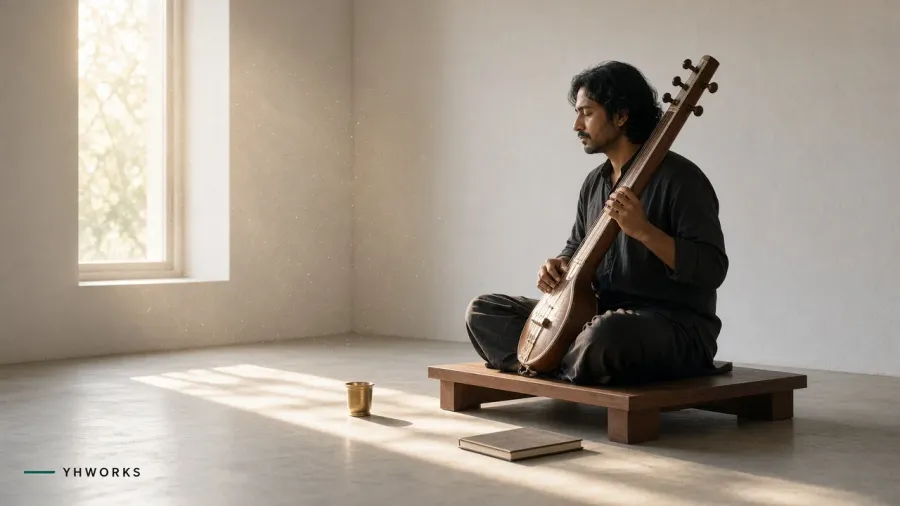
In Indian classical music there is a practice called riyaz. A musician returns to the same ragas every morning, often for an entire lifetime. Someone watching from outside might ask the same question my client asked: isn’t that boring? Yet the great masters have spoken of riyaz as the part of their life they would least give up. The raga stays the same; the musician does not. Each morning they hear something they could not hear the day before.
Far away, in a small sushi restaurant in Tokyo, Jiro Ono was still refining his craft well into his eighties, working on the same few dishes he had made for decades and still convinced he had not yet reached the best version of them. Japanese manufacturing gave this attitude a name, kaizen: small, continuous improvement, done by people who assume that today’s best is only a starting point.
None of them are bored. Repetition is boring only when you stop looking. When you keep studying, the same work keeps revealing something new.
The quiet takeaway
So yes, we study every project, including the ones we could build with our eyes closed. Especially those ones. It is how a twenty-year-old habit stays fresh, and it is how our clients get the answer that fits today, not the one that fitted someone else five years ago.
The study is not a cost we pay before the real work begins. It is the real work. And it is the reason we still enjoy it.
If This Sounds Like Your Team
If you have ever received a solution that felt copied from someone else’s project, familiar, generic, and slightly wrong for your business, you know what skipped study costs.
We begin every engagement by understanding your users, your workflow, and your constraints as they are today, however many times we have worked in your domain before. Book a consultation with one of our founders, and we will show you how that first study shapes everything that follows.