· Dinesh Gajjar · Insights · 5 min read
What Custom Software Actually Costs in 2026 (And What Quietly Inflates the Bill)
The same brief can get quotes of ₹6 lakh, ₹18 lakh, and "let us talk." Here is why custom software quotes vary so widely — and what quietly inflates the bill.
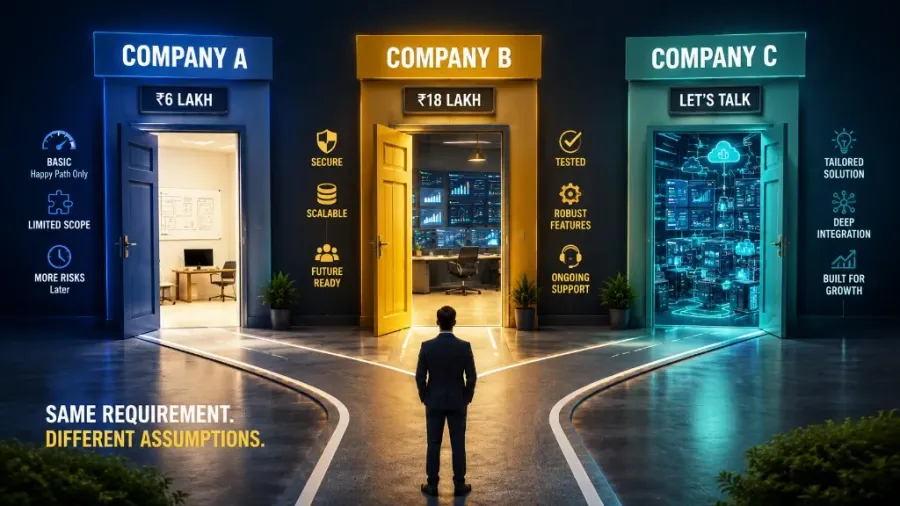
A founder called me a few weeks ago, half-frustrated, half-amused. He had asked three companies to quote the same project. One said ₹6 lakh. One said ₹18 lakh. One said “let us talk.” Same brief. Same five-page document. He wanted to know which one was lying.
None of them were.
That is the uncomfortable truth about custom software pricing, and it is the thing nobody explains before you go shopping. So let me try — not to sell you anything, but because I have watched too many good businesses burn a budget on the wrong assumptions.
Why the same project gets wildly different quotes
A software quote is not a price tag. It is a bet on how well someone understood what you actually need. When three vendors read your brief, they are each imagining a different product — and pricing the one in their head.
The ₹6 lakh quote usually imagines the happy path: the screens work, the buttons click, the demo looks great. The ₹18 lakh quote imagined everything that happens after the demo — the edge cases, the person who enters an emoji where a phone number should go, the day you have 500 users instead of 5, the security review, the fact that someone has to maintain this thing for the next three years.
Cheaper is not a discount. It is usually a smaller imagination.
What you are really paying for
Roughly, the money goes into four buckets, and only one of them is “writing code”:
Thinking before building. The most expensive mistakes are decisions, not bugs. Time spent scoping, questioning, and pushing back on your own brief is the cheapest insurance you will ever buy. When someone skips this to give you a fast number, you pay for it later — with interest.
The unglamorous 60%. Users see the screens. They never see login security, data validation, error handling, payment reconciliation, or the admin tools your own team needs. This is most of the actual work, and it is the first thing that gets quietly dropped from a lowball quote.
Change. Your requirements will change — not because you are indecisive, but because you will learn things once real people touch the product. Good pricing accounts for this. Rigid pricing punishes you for it.
Keeping it alive. Software is not a building you finish. It is a garden. Servers, updates, security patches, the small fixes that keep it from rotting. If nobody mentioned this, it was not included.
What quietly inflates the bill
In fairness, the direction runs both ways. Here is what makes projects cost more than they should:
- Vague scope. “Something like Airbnb” is not a spec. Every unspoken assumption becomes a renegotiation, and renegotiations are where budgets go to die.
- Features nobody uses. Teams routinely pay to build things that sound essential in a meeting and get opened twice a year. A good partner talks you out of these.
- Rebuilding what you could buy. Not everything needs to be custom. Payments, notifications, maps — sometimes the smart move is to plug in an existing service and spend your budget where it actually differentiates you.
- Changing course late. Rearranging a wall while the house is framed is cheap. Doing it after the plumbing is in is not.
A quick word on AI, since everyone is asking
There is one more thing worth adding, because it comes up in almost every conversation now. AI-enabled development has genuinely changed the pace of things. It brings speed. It brings better accuracy, wider test coverage, and a lot more automation — to the point where work that used to take five weeks can now take one. That is not hype; we see it on real projects.
But here is what has not changed, and I want to be honest about it: AI writes the code faster. It does not decide what to build. The one question it cannot answer for you is still the one that matters most — what are you actually trying to make, and for whom? Get that wrong, and AI just helps you build the wrong thing five times faster.
So what should you actually do?
Before you collect a single quote, get honest about one question: what is the smallest version of this that would prove people want it? Not the full vision — the smallest true test. Price that first. You can always build the cathedral once you know people will show up.
And when the quotes come in and they are all over the map, do not reach for the cheapest one. Reach for the one whose questions made you think. The vendor who understood your problem best will usually cost you the least by the end — even if they do not cost the least at the start.
At YHWorks, we have spent years building custom software for companies across India, the US, Canada, and Europe — and a fair amount of that time is spent talking clients out of things they do not need. If you are weighing a project and want a straight answer about scope and cost, that first conversation is free and genuinely no-pressure. We would rather help you decide well than sell you something twice.