· Dinesh Gajjar · Insights · 6 min read
Nobody Applauds the Bridge That Doesn't Collapse
The most important work is often the work nobody ever notices.
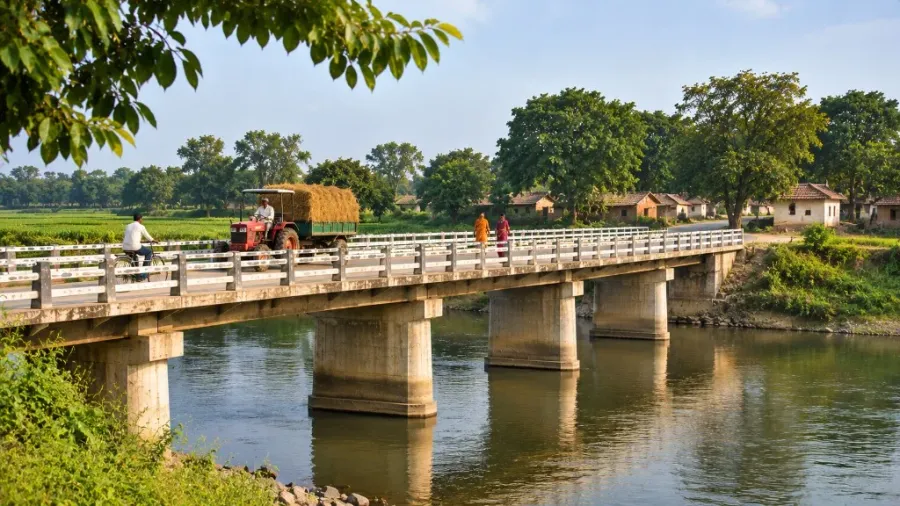
There were two villages separated by a river.
For years, the river had been part of their lives. It gave them water, nourished their fields and occasionally reminded them of its power. But it also made everyday life unnecessarily difficult. Children took longer routes to school. Farmers lost precious time carrying their produce to the other side. Visiting a relative in the neighbouring village sometimes meant waiting for the water to recede.
Eventually, the villagers decided that it was time to build a bridge.
They invited two engineers to present their proposals.
The first engineer arrived with an impressive presentation. His drawings were beautiful. The bridge was wide, elegant and modern. He explained the materials, the design, the construction schedule and how the bridge would transform life between the two villages.
The villagers were impressed.
The second engineer arrived with drawings too, but his meeting was rather different.
He asked questions.
How high did the river rise during the monsoon?
How strong were the currents?
What kind of vehicles would cross during harvest season?
What happened to the riverbed after heavy rains?
How would the foundations withstand the changing conditions over the years?
The villagers found the questions a little uncomfortable. They had come to evaluate bridge designs, not to participate in what seemed like an endless interrogation.
The first engineer had shown them what the bridge would look like.
The second engineer wanted to understand what the bridge would have to endure.
The villagers chose the first engineer.
His design was attractive. His presentation was convincing. And, at that moment, it seemed to be exactly what they needed.
The bridge was built. There was an inauguration, speeches, photographs and the excitement of finally connecting the two villages.
For a while, everything worked as expected.
Then came the monsoon.
Three years later
The bridge had stood through two monsoons. The villagers had grown accustomed to it. Life had become easier, and the bridge was no longer something they thought about every day.
Then, during the third monsoon, the river swelled beyond what the villagers had seen in recent years.
The water rushed through with force, carrying branches, debris and stones. By morning, part of the bridge had collapsed.
Fortunately, nobody was on it when it happened.
The bridge was closed. The two villages were separated once again. Farmers returned to longer routes. Children had to travel farther. What had once seemed like a permanent solution had become a painful reminder of a decision made too quickly.
The villagers remembered the second engineer.
The one who had asked so many questions.
They approached him again, this time with a different attitude. They didn’t ask for the most attractive design. They didn’t ask how quickly it could be built. They didn’t ask for a presentation.
They asked him to build a bridge that would last.
The engineer listened. He revisited the site, studied the river, considered the terrain and its behaviour, and designed a bridge based on what he had learned.
He didn’t remind the villagers that they had rejected him earlier.
He didn’t tell them that he had been right.
He simply got to work.
The bridge was eventually completed.
There was no grand inauguration this time. No speeches. No celebrations. Perhaps the villagers were still skeptical. Perhaps they had learned that a bridge is not proven on the day it is built.
They simply began crossing it.
And it remained.
Through monsoons, summers, harvests and changing generations, the bridge continued to connect the two villages.
Children who had once walked the long route grew up and crossed it with their own children. Farmers carried produce across it. People visited relatives, attended weddings and returned home in the evenings.
Years turned into decades.
The bridge became part of the landscape.
And eventually, nobody gave it much thought.
The things we don’t see
There is something rather curious about the way we value things.
We celebrate what is visible.
The beautiful building. The impressive machine. The elegant application. The clever new technology.
But we rarely think about what happens underneath.
We don’t notice the calculations that keep a bridge standing. We don’t see the decisions that prevent a building from developing cracks. We don’t think about the thousands of small considerations that make something dependable.
Software is no different.
Today, we live in an exciting time. Artificial intelligence can write code, generate designs, analyse information and help turn ideas into working prototypes at remarkable speed.
What once took months can sometimes be demonstrated in days.
And that is genuinely exciting.
But getting something to work and building something people can depend on are two very different achievements.
An application that works beautifully in a demonstration may behave differently when thousands of people use it.
A payment system may appear perfectly fine until a transaction fails halfway through.
A business platform may look impressive until two departments need to share the same information.
An AI-powered feature may produce an extraordinary result in one situation and a completely unexpected one in another.
The challenge was never just to make something work.
The challenge is to make it work when circumstances are less than perfect.
The questions that matter
I sometimes think good engineers are a little like that second bridge builder.
They spend an unusual amount of time thinking about things that customers may never ask about.
What happens when the internet disappears?
What if a user enters something nobody anticipated?
What happens when the business doubles in size?
Can the system recover when something goes wrong?
Will the next developer understand what has been built?
Can the business change direction without having to rebuild everything?
These questions don’t necessarily make for exciting product demonstrations. They don’t look particularly impressive in a presentation. They may even make a project sound more complicated than it initially appeared.
But they matter.
And as AI makes it easier to create software, the judgement behind building dependable software becomes even more important.
The tools may change. The speed may change. The way we write code may change.
The responsibility of building something people can trust does not.
Perhaps the real lesson
Perhaps the villagers weren’t wrong to be impressed by the first engineer. His design was attractive. His presentation was persuasive. Those things aren’t inherently bad.
The mistake was believing that what they could see was all that mattered.
When choosing someone to build your next application, platform or business system, it is natural to compare proposals, timelines, costs and features.
Those things matter.
But there are other questions worth asking.
Who is thinking about what happens after launch?
Who is considering the business five years from now?
Who is asking questions beyond the list of features?
Who is thinking about the things that could go wrong before they actually do?
Because the cost of building something is only one part of its cost.
The cost of living with it is another.
At YHWorks, we believe good product engineering is not simply about getting an idea onto a screen. It is about understanding the people who will use it, the business that will depend on it and the future it needs to support.
We enjoy building things that work. But we take even greater satisfaction in building things that continue to work.
After all, nobody applauds a bridge every morning because it hasn’t collapsed.
They simply cross it.
And perhaps that is the highest compliment good engineering can receive.
Building something that needs to last? Let’s talk.